


Let’s be honest. When we stand in front of the mirror in the morning and notice that our once-flat belly has somehow lost its contours, the first emotion is pure frustration.
It infuriates us. We want to erase that spare tire, work it out, starve it out. We view our own stomach as an enemy that has betrayed us.
But what if I told you that this famous “belly” is not just a passive layer of lard?
Modern biochemistry has revealed a fascinating truth: visceral fat is actually a standalone, highly intelligent, and dynamic organ. It is an organ that produces its own hormones, dictates our mood, influences our immunity, and right now, it is screaming for help.
When you enter the Golden Flow protocol, your body doesn’t immediately start burning subcutaneous fat on your thighs. No. The first thing it releases is a massive wave of inflammatory water right from the abdominal area. Why? Because the body knows this internal organ is in danger and needs acute resuscitation.
Let’s descend deep beneath the surface of our intra-abdominal world.
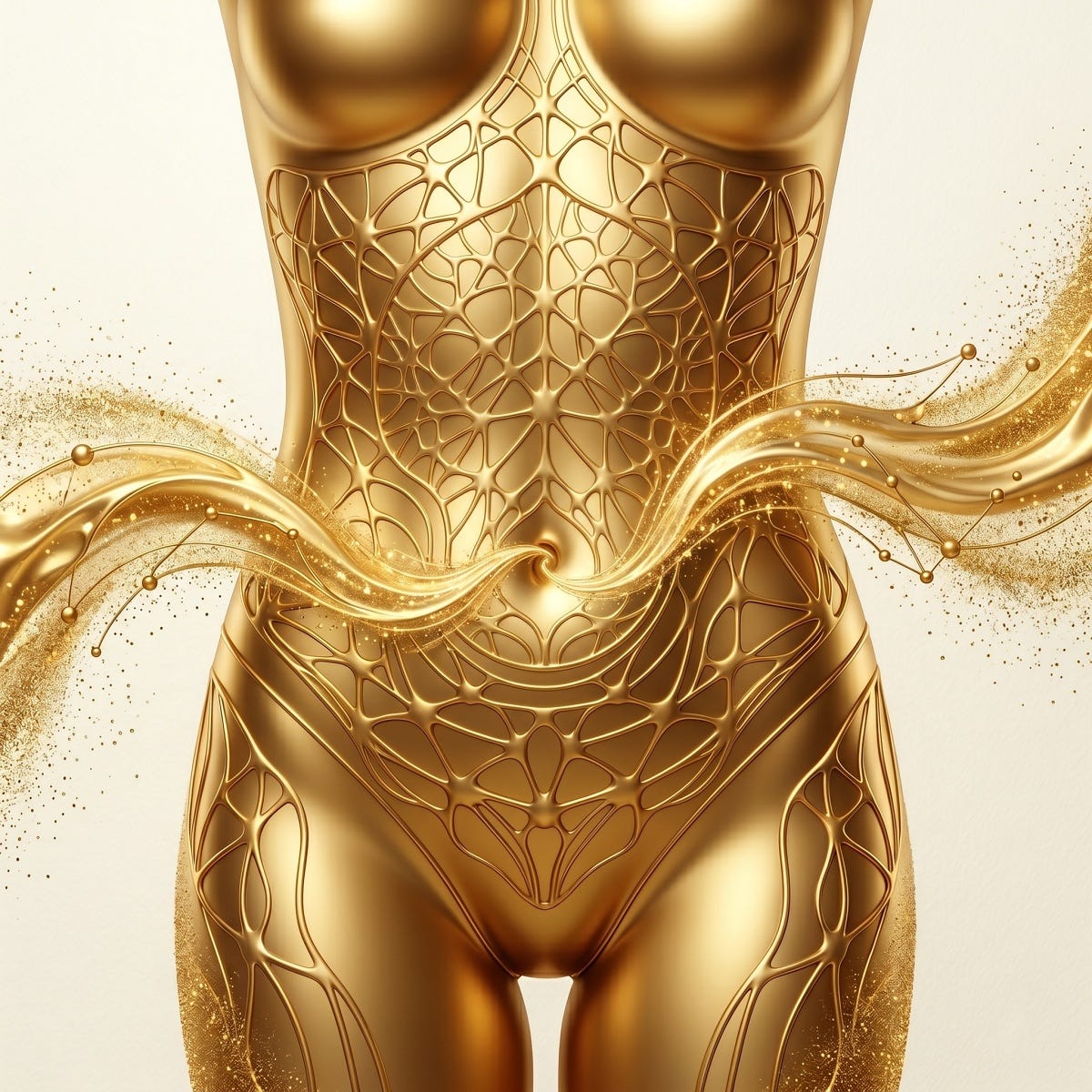
A Friend in Need, Not an Enemy
Visceral fat is not the subcutaneous flab you can pinch with your fingers. It is hidden deep within the abdominal cavity, wrapping around our key vital organs—the liver, stomach, kidneys, and intestines.
Evolutionarily, it is our ultimate protector. Here is what it does:
The Hydraulic Shock Absorber: It physically shields internal organs from mechanical trauma during a jump, fall, or run.
The Thermal Insulator: It maintains a stable core temperature so that the enzymatic processes in your liver and gut don’t freeze.
The Immune Shield: It contains a massive concentration of immune cells that trap toxins and bacteria, preventing them from breaching the intestinal wall (the so-called leaky gut syndrome).
The problem arises when we overwhelm this “friend” with a modern lifestyle. It never wanted to grow to monstrous proportions. But once it gets overloaded, it transforms into a toxic hormonal factory.
The Hormonal Cocktail of the Visceral Organ
Because visceral fat is a highly active endocrine organ, it secretes chemicals that can literally hijack our metabolism and our mood. When this organ is congested and inflamed, instead of protecting us, it begins to mix a toxic hormonal cocktail into our system.
Let’s break down its three main ingredients:
1. Leptin (The Satiety Hormone That Stopped Working)
Fat cells naturally produce leptin to send a clear message to the brain: “We are full, we have plenty of energy, no need to eat anymore”. Logically, you would think that the more visceral fat we carry, the more leptin circulates in our blood, and the less hunger we should feel.
But nature designed a cruel twist. Under chronically high doses of leptin, our brain grows numb and stops registering the signal—creating leptin resistance.
The result is a fascinating yet brutal paradox: a person carries a massive stomach packed with stored energy, yet their starved brain genuinely believes the body is starving. This is exactly what triggers those uncontrollable, panic-driven cravings at the grocery store where you want to buy everything on the shelves, or those midnight raids on the fridge.
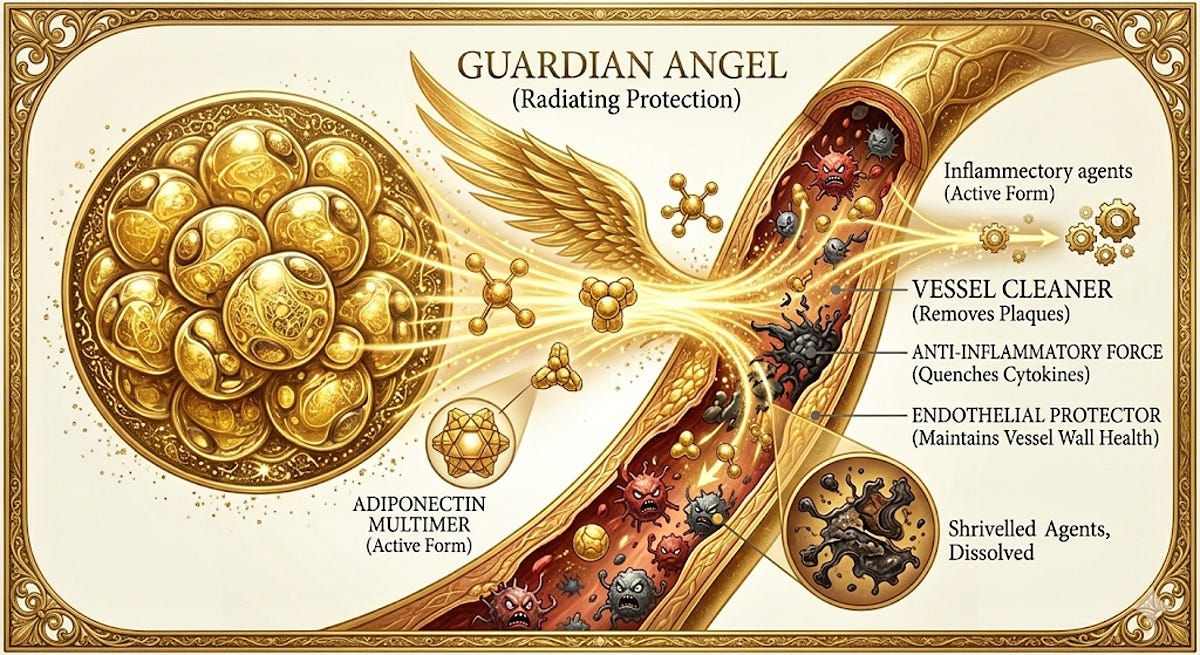
2. Adiponectin (Our Guardian Angel and Vessel Cleaner)
This incredible hormone serves as our internal brake on inflammation. Think of it as a tireless maintenance manager - circulating through your bloodstream, scrubbing nants off vessel walls, and literally unlocking the cellular doors for insulin (increasing insulin sensitivity).
The healthier and smaller the visceral fat is, the more of this protector it pumps out. However, the moment the visceral organ becomes overloaded, its cells begin to suffocate from a lack of oxygen, and adiponectin secretion plummets almost to zero.
In that second, the body loses its best firefighter, opening the floodgates to chronic lifestyle diseases. This internal abdominal inflammation then spills over into the entire system, manifesting in places you would least expect.
Can it cause eczema? Absolutely. Eczema is almost always an external mirror of an inflamed interior. The toxins from the overloaded visceral fat overwhelm the liver. The liver fails to clean the blood fast enough, so the body recruits its largest emergency detoxification organ - the skin.
The anatomical reality is just as harsh when we look at reproductive organs and ovarian adhesions. Since visceral fat physically sits in the abdominal cavity in tight proximity to the uterus and ovaries, its constant micro-inflammation literally “scorches” surrounding tissues. The body tries to isolate and repair these irritated areas by creating scar tissue - and those are the notorious, painful adhesions and fibroids. Healing your visceral fat is therefore the absolute key to healing the female womb.
3. Inflammatory Cytokines (TNF−α, IL−6)
This is the darkest side of an overloaded abdominal organ. Inflamed visceral cells begin pumping aggressive immune chemicals - inflammatory cytokines - directly into the portal vein (which flows straight into the liver). This silent, chronic micro-inflammation then travels through the bloodstream across the entire body. In one person, it manifests as rheumatic joint pain; in another, it irritates the vessels around nerve endings, creating hidden hot spots that go unnoticed for years until a serious disease suddenly breaks out.
The Unholy Trinity: Insulin, Cortisol, and Visceral Fat
What actually triggers this toxic cocktail in our belly and keeps it alive? It is the unholy trinity between insulin (the storage hormone), cortisol (the stress hormone), and visceral fat. They operate as a closed loop, where one ruthlessly drives the other:
Step 1 (The Insulin Spark): Every time you eat a diet rich in fast carbohydrates or constantly graze on snacks throughout the day, your body floods your system with insulin. Its job is to sweep sugar out of the blood and uncompromisingly lock energy away into fat cells.
Step 2 (The Cortisol Accelerator): On top of that, enter modern, chronic stress and lack of sleep. Your adrenal glands begin pumping out the stress hormone cortisol. Cortisol has an evolutionary role: to instantly flash an extra dose of sugar into the blood so you have immediate energy to fight a predator or flee. Except you aren’t fleeing anywhere; you are sitting at your desk or in your car, stewing in anger.
Step 3 (The Visceral Magnet): In this exact second, you have a massive amount of insulin circulating in your blood alongside free stress-sugar from cortisol. And here lies the ultimate biochemical trap: visceral fat contains up to 4 times more cortisol receptors than regular subcutaneous fat on your legs or arms! Visceral fat acts as an incredibly powerful magnet—it literally sucks this stress-sugar out of the blood and locks it deep inside your stomach.
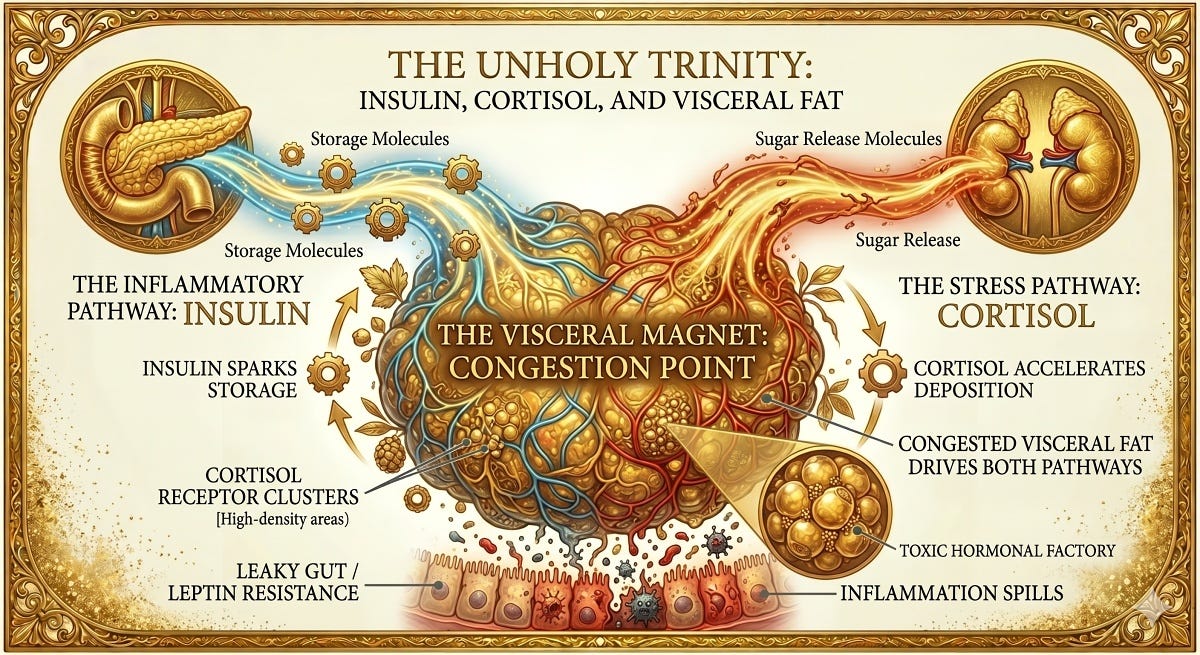
The worst part? This loop self-reinforces. The suffocating, compressed visceral fat increases the body’s baseline stress level on its own, because its oxygen-deprived cells continuously broadcast an emergency distress signal to the brain. The brain responds to this alarm by flooding the body with even more cortisol. It is a miserable state where a person gains belly fat and loses their flat contours even when eating almost nothing—because they are gaining weight purely from stress and chronically elevated insulin.
Inflammatory Water: Why the Belly Shrinks Rapidly After 2 Days of Fasting
Perhaps you’ve experienced it yourself, or maybe you are seeing it right now on your partner: a person stops eating, and within 72 hours, their stomach looks visually half its size. How is it possible to lose “fat” that quickly? The answer is: you didn’t lose fat; your body received the signal to flush out inflammatory water.
When visceral fat is diseased and pumping out inflammatory chemicals, the immune system responds the exact same way as when you sprain an ankle - it sends water to the abdominal cavity to dilute and cool down the inflamed environment. You are carrying a literal intracellular swelling (edema) in your gut.
What causes the body to dump this water? The moment you switch into a guided fast or a strict liquid phase, your insulin levels plummet to zero. Insulin is the primary holder of sodium and fluid in the kidneys. When insulin disappears, the kidneys receive an immediate command: “Release sodium, flush the water!” At the same time, due to the absence of incoming food, the inflammation in both the gut and the visceral fat quiets down. The immune system realizes the “fire” is out.
This massive internal abdominal swelling literally drains into the kidneys, and you simply pee it out during the first few days of fasting. The organs in your belly finally get room to breathe, and you see your true, undeformed contours.
The Internal Belt and Shattering Old Chains
The visceral organ doesn’t just cooperate with biochemistry; it works with our anatomy, too. As deep intra-abdominal fat expands, it creates immense pressure from the inside out.
Think of your abdominal muscles and their fascia as your natural internal weight belt. This belt is supposed to keep your organs held firmly in place. But when visceral fat gets inflamed and swells, it mechanically unbuckles this belt. The muscles shut off, the fascia stiffens, and everything freezes in an unnatural, overstretched position. The body loses core stability, and the lower back usually pays the price.
And then there is that crucial anchor point up top - the attachment at the breastbone. In the old regime, the pressure from the belly pushes the diaphragm upward, forcing us to breathe shallowly and superficially. The fascia around the breastbone and ribs hardens, fusing into a stiff, rigid “armor”.
When we begin practicing deep breathing exercises (like Qi Gong) within the Golden Flow protocol, a fascinating thing happens: we physically shatter these old fascial chains. We release the locked tissue around the sternum, allowing the diaphragm to drop once again. Upon the ruins of the old, inflamed, and rigid fascia, the body immediately begins building new, soft, and elastic tissue. Our internal belt begins to tighten once more.
First Aid, Golden Flow Style: Guided Fasting
Once we realize that our expanded belly is actually a sick, inflamed organ, our entire strategy changes. We no longer want to destroy it. We want to give it emergency first aid.
And the fastest, most effective first aid in the world is a guided liquid fast. With no food entering the body, insulin sleeps, the inflammation dies down, and the cells of the visceral organ enter a state of autophagy - a mode of deep cellular housecleaning. They literally begin to consume the inflamed cells and old, damaged collagen. The liver catches its breath, and the visceral fat starts producing protective adiponectin once again.
My partner is currently on day 7 of this intense reset. His visceral organ is undergoing a massive reconstruction, his waistline shrinked by more than 10 cm. The weight is flying off, but more importantly - the intra-abdominal pressure is completely gone.
Shedding visceral fat isn’t about aesthetics. It is about liberating your internal organs from under a toxic mountain of sludge. Today, I know that my missing flat belly won’t return through starvation born out of despair, but through the conscious healing of this amazing organ that had my back for so long.
Give your body a chance at Golden Flow. It deserves it.
What do you think? Have you ever looked at your belly fat as a separate organ that is actively communicating with you? Let me know in the comments below...
The body is incredible! Thank you for this information.